Understand Your True Body Composition
We have all experienced that disappointing moment when we step on the bathroom scale after a long week of eating clean and exercising, only to watch the number stay exactly where it was. Sometimes the stubborn display even goes up. It is incredibly frustrating and makes many people want to stop working out altogether.
But that weight reading is not telling you the entire story.
Your scale weight is just a single number showing everything combined. It reflects your water content, heavy bones, muscles rich in protein, main organs, and body fat. Tracking your body fat percentage is the absolute best way to figure out your true fitness level and see real physical change over time. If you only look at your weight, you are flying blind.
What is Body Fat Percentage and Why Does it Matter?
Your body fat percentage is simply the total mass of your fat tissue divided by your overall weight. This separation is crucial because it divides your fat mass from your fat-free mass. Your fat-free mass (often called lean body mass) includes your active muscles, bones, water, and vital organs. Keeping track of this distinction protects you from making common dieting mistakes.
If you focus only on losing total weight, you might accidentally lose precious muscle tissue instead of fat. Muscle is highly active tissue that supports your resting metabolism. When you lose muscle, your metabolism slows down, which makes keeping weight off in the future much harder. Focusing on body composition ensures you keep your muscle and only drop the excess fat.
To calculate these values, we use two simple formulas:
Fat Mass Formula:
Fat Mass = Total Weight x (Body Fat Percentage / 100)
Lean Mass Formula:
Lean Mass = Total Weight - Fat Mass
The Big Problem with Body Mass Index (BMI)
Many doctors and clinics still rely on the simple Body Mass Index as a main health assessment tool. BMI calculates a score based purely on your height and weight using these formulas:
BMI (Metric) Formula:
BMI = Weight in Kilograms / (Height in Meters)²
BMI (Imperial) Formula:
BMI = 703 x Weight in Pounds / (Height in Inches)²
This leaves a massive blind spot because the equation cannot tell the difference between five pounds of dense muscle and five pounds of body fat.
This mathematical limitation is why a heavily muscled athlete can easily be labeled overweight or obese on a standard chart. It is an inaccurate health risk assessment for active individuals. Similarly, someone with low muscle levels can have a healthy range score on the chart while actually carrying a dangerous amount of internal body fat. Attempting to convert BMI to fat percentage using simple tables is highly unreliable for this exact reason.
The Six Body Fat Estimation Formulas
This calculator allows you to select from six different body fat estimation methods. Below is a detailed breakdown of how each formula works, what sites are measured, and the math used behind the scenes.
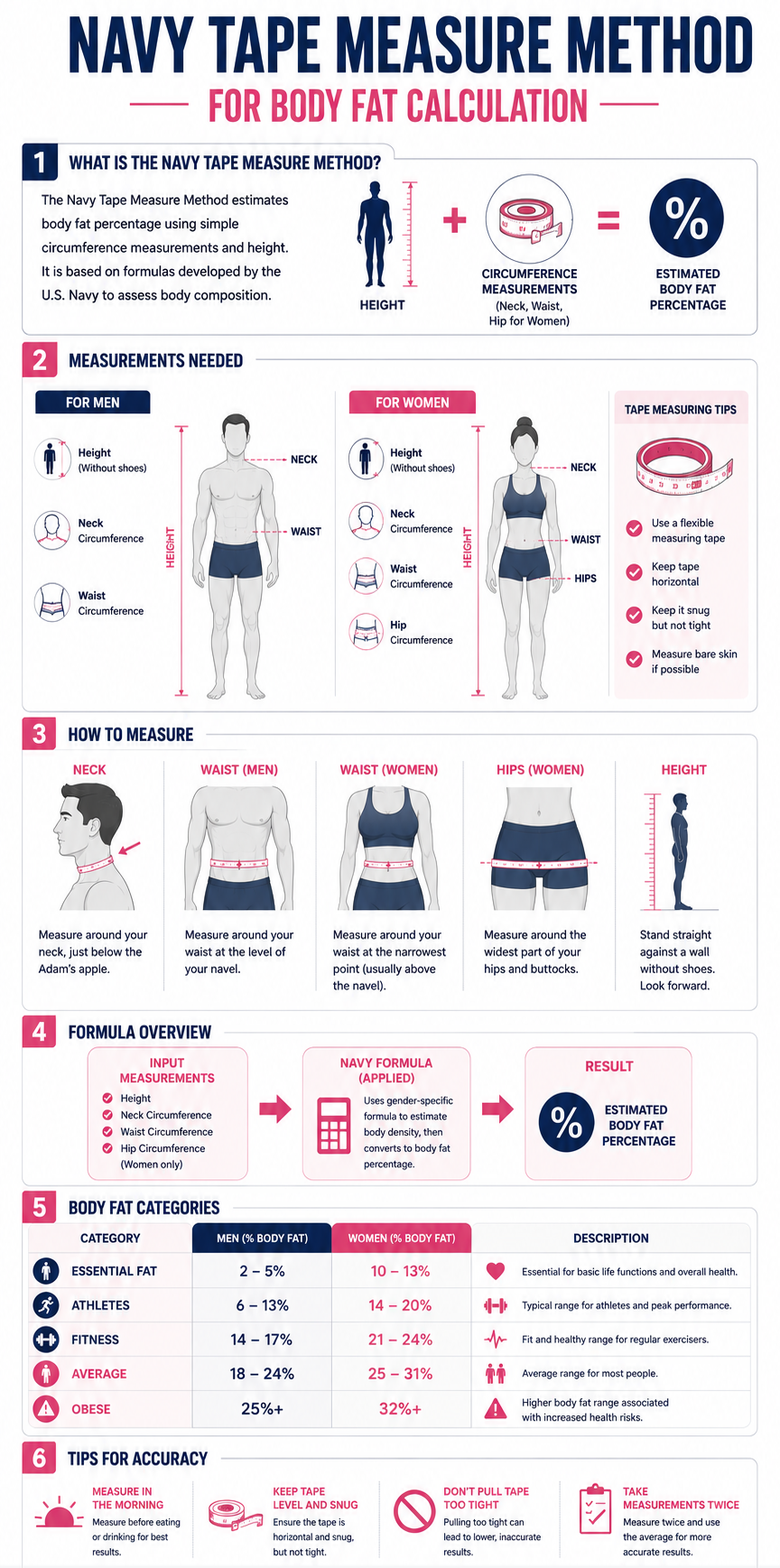
1. Navy Tape Measure Method
This is the most popular starting point because it requires nothing but a simple, flexible tape measure. Developed by the US Navy, this method uses specific circumference readings to calculate physical volume. It works exceptionally well for general fitness tracking at home.
The mathematical equations utilize logarithmic scales to map out human body density:
For Men (using imperial measurements in inches):
Body Fat % = 86.010 x log10(Waist - Neck) - 70.041 x log10(Height) + 36.76
For Women (using imperial measurements in inches):
Body Fat % = 163.205 x log10(Waist + Hip - Neck) - 97.684 x log10(Height) - 78.387
For Men (using metric measurements in centimeters):
Body Fat % = [ 495 / (1.0324 - 0.19077 x log10(Waist - Neck) + 0.15456 x log10(Height)) ] - 450
For Women (using metric measurements in centimeters):
Body Fat % = [ 495 / (1.29579 - 0.35004 x log10(Waist + Hip - Neck) + 0.22100 x log10(Height)) ] - 450
(Note: All log values in these equations are base-10 logarithms.)
2. 3-Site Skinfold (Jackson-Pollock)
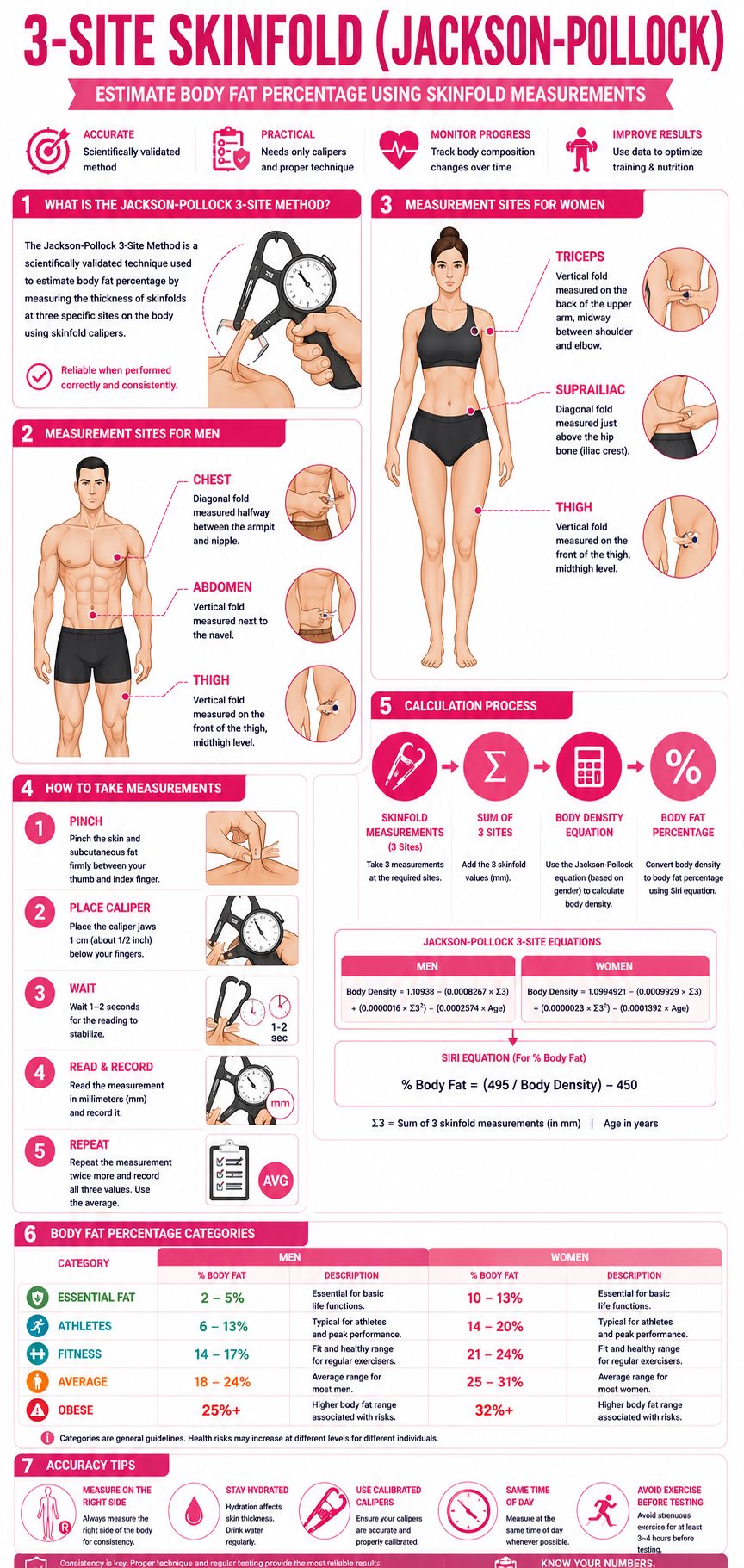
The 3-site Jackson-Pollock method is a classic skinfold caliper approach. It requires pinching the fat layers at three targeted locations. It balances ease of use with solid accuracy.
- Male Sites: Chest, Abdomen, Thigh
- Female Sites: Triceps, Suprailiac (hip), Thigh
The formulas first calculate body density (BD), which is then converted to body fat percentage using the standard Siri equation:
For Men (Body Density):
BD = 1.109380 - (0.0008267 x S) + (0.0000016 x S²) - (0.0002574 x Age)
For Women (Body Density):
BD = 1.0994921 - (0.0009929 x S) + (0.0000023 x S²) - (0.0001392 x Age)
(Where S is the sum of the three skinfold measurements in millimeters.)
Once you have the body density, use this equation to get the final percentage:
Siri Equation:
Body Fat % = (495 / BD) - 450
3. 4-Site Skinfold (Jackson-Pollock)
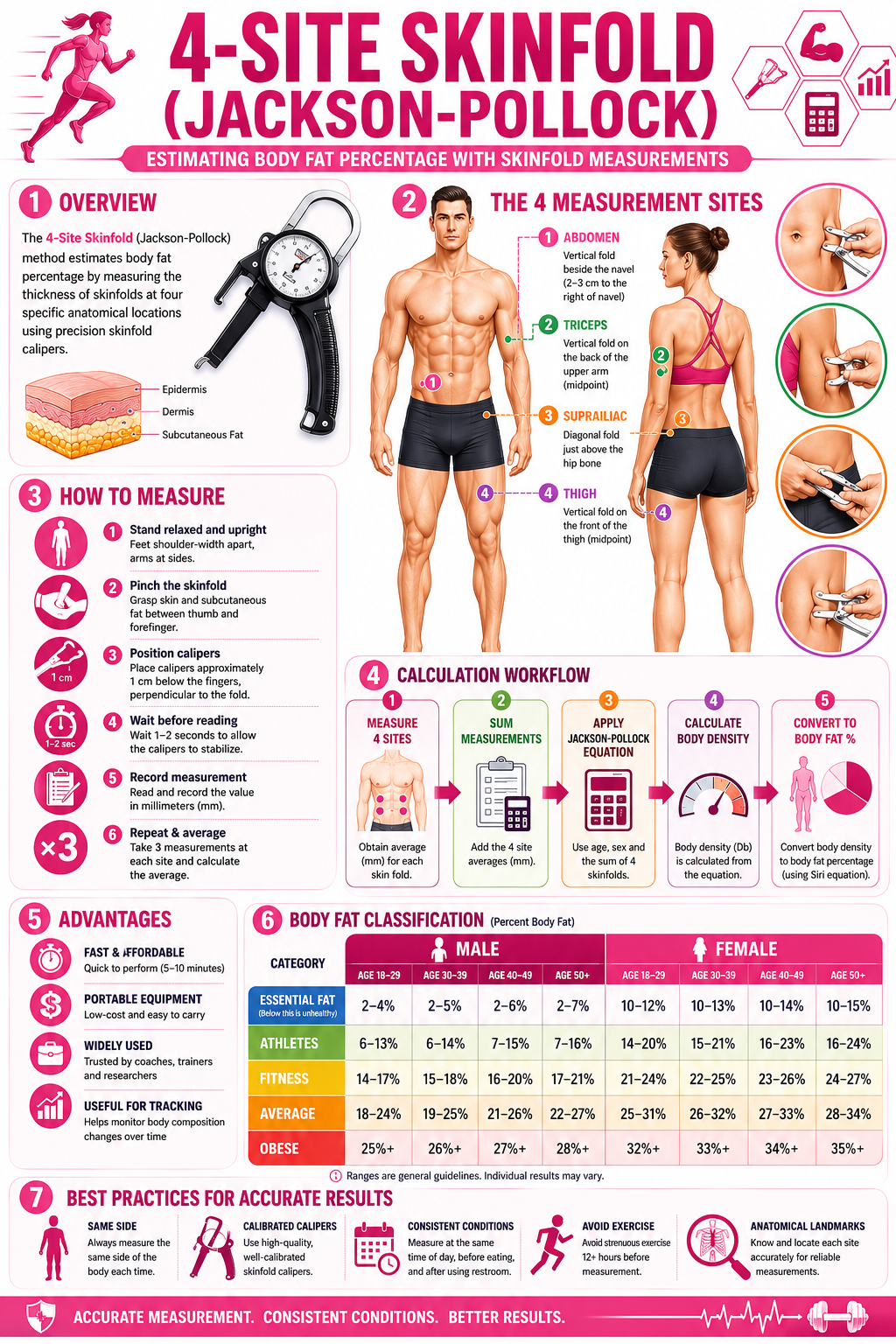
If you want a skinfold formula that does not require calculating intermediate body density values, the Jackson-Pollock 4-site method is an excellent choice. It works for both genders using the same anatomical locations.
- Sites measured: Abdomen, Suprailiac, Triceps, Thigh
For Men:
Body Fat % = (0.29288 x S) - (0.0005 x S²) + (0.15845 x Age) - 5.76377
For Women:
Body Fat % = (0.29669 x S) - (0.00043 x S²) + (0.02963 x Age) + 1.4072
(Where S is the sum of the four skinfold measurements in millimeters.)
4. 7-Site Skinfold (Jackson-Pollock)
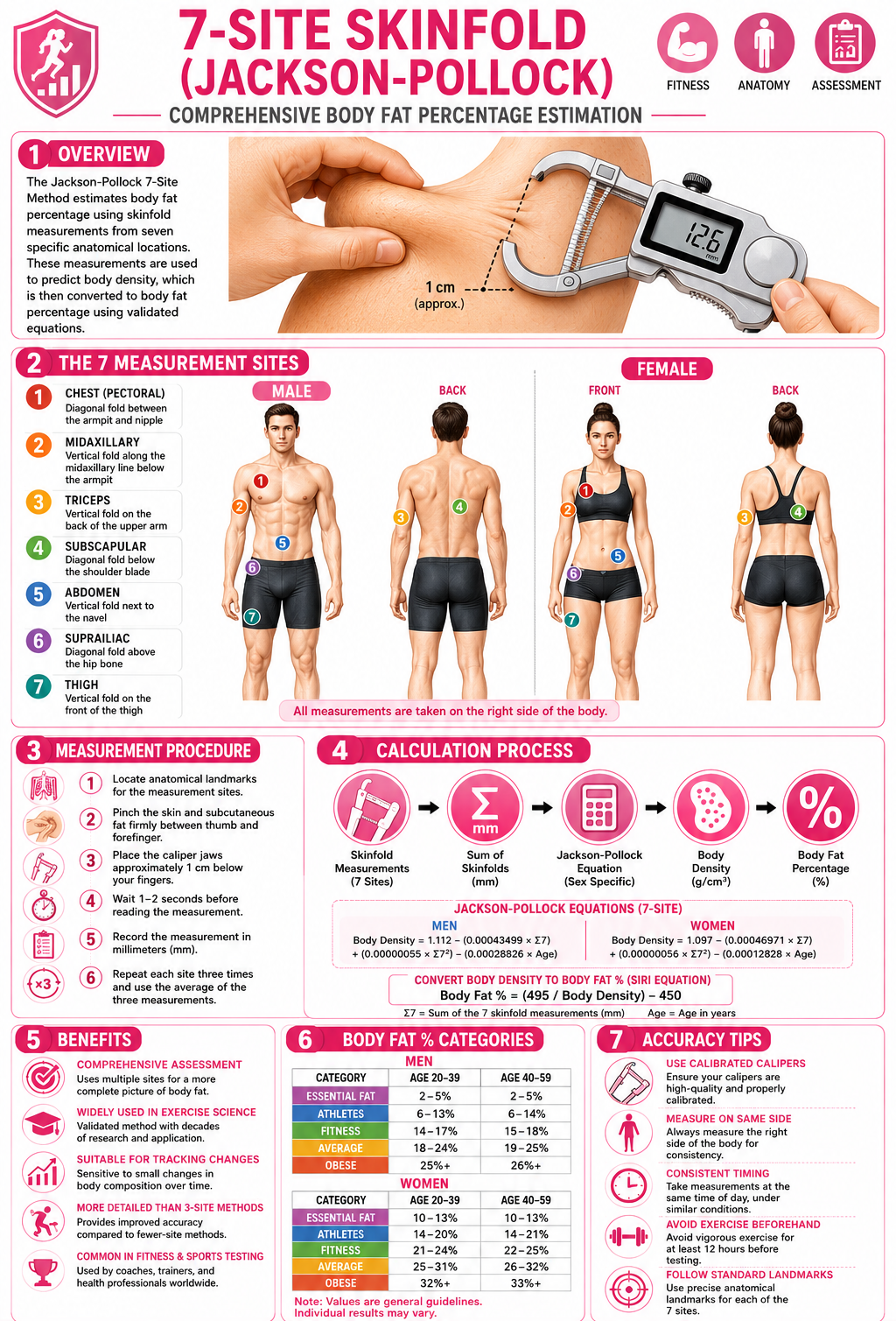
This is considered the gold standard of caliper testing. By measuring seven different areas across the body, it accounts for varied fat distribution patterns, making it highly accurate for athletes and bodybuilders.
- Sites measured: Chest, Midaxillary (underarm), Triceps, Subscapular (shoulder blade), Abdomen, Suprailiac, Thigh
For Men (Body Density):
BD = 1.112 - (0.00043499 x S) + (0.00000055 x S²) - (0.00028826 x Age)
For Women (Body Density):
BD = 1.097 - (0.00046971 x S) + (0.00000056 x S²) - (0.00012828 x Age)
(Where S is the sum of all seven skinfold measurements in millimeters.)
Convert the body density to body fat using the Siri equation:
Body Fat Formula:
Body Fat % = (495 / BD) - 450
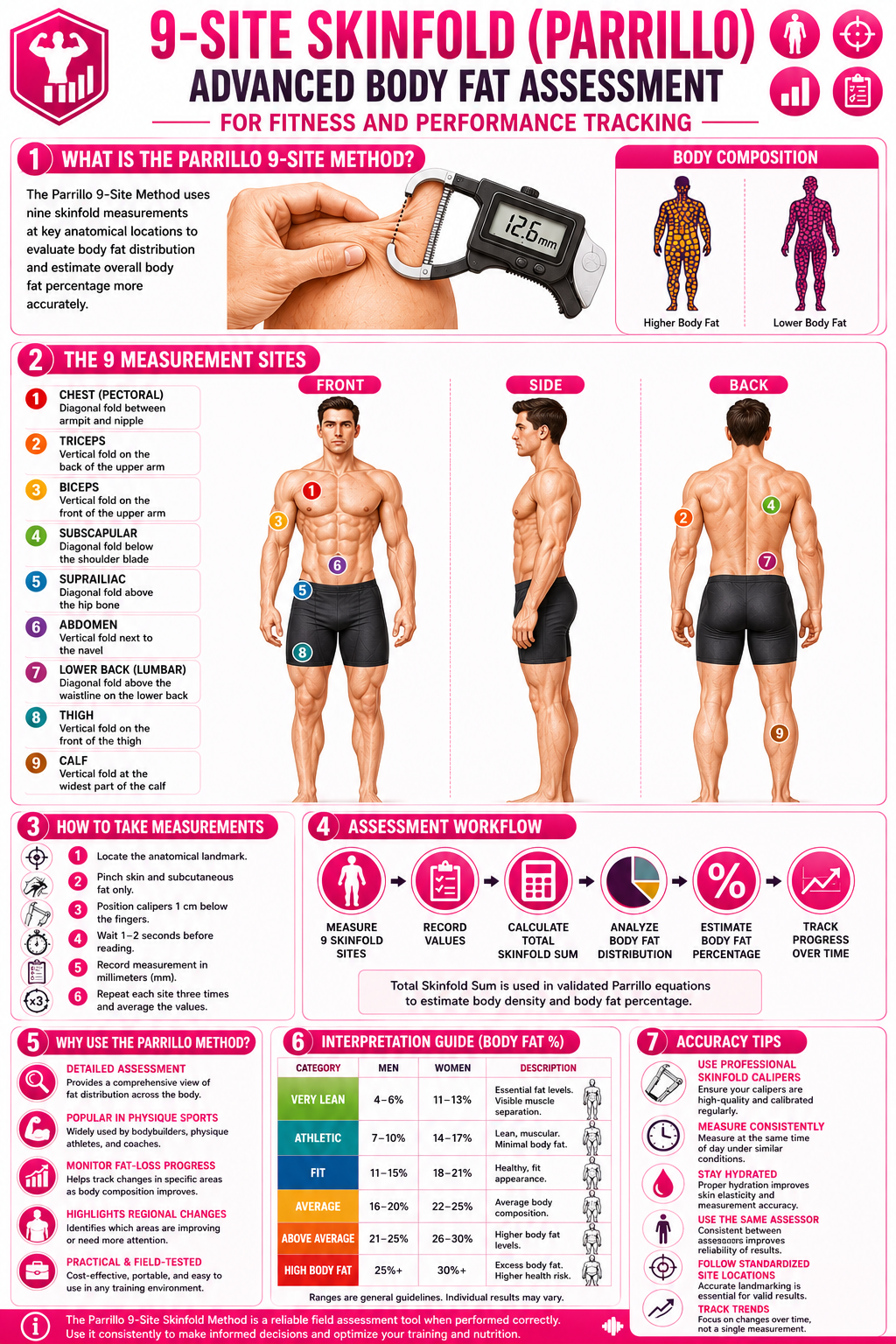
5. 9-Site Skinfold (Parrillo)
Created by renowned bodybuilding coach John Parrillo, this equation is designed specifically for highly active, lean individuals and competitive bodybuilders. It takes a detailed visual assessment of subcutaneous fat across nine distinct spots.
- Sites measured: Chest, Abdominal, Thigh, Biceps, Triceps, Subscapular, Suprailiac, Lower Back, Calf
The Parrillo equation uses a direct calculation that factors in your total body weight:
Parrillo Formula:
Body Fat % = (27 x S) / Body Weight in Pounds
(Where S is the sum of all nine skinfold measurements in millimeters.)
(Note: If you measure your weight in kilograms, multiply it by 2.20462 to convert it to pounds before using this formula.)
6. 4-Site Skinfold (Durnin/Womersley)
This method is highly regarded for its reliability across various adult age brackets. Rather than using quadratic equations, it uses a logarithmic scale of the sum of four specific upper-body skinfolds.
- Sites measured: Biceps, Triceps, Subscapular, Suprailiac
The formula calculates body density using age-adjusted and gender-specific constants:
Durnin/Womersley Body Density Formula
BD = C - (M x log10(S))
(Where S is the sum of the four skinfolds in millimeters. Use the table below to find your specific C and M constants.)
| Gender | Age Group | Constant C | Constant M |
|---|---|---|---|
| Male | 17 to 29 | 1.1620 | 0.0630 |
| Male | 30 to 39 | 1.1422 | 0.0544 |
| Male | 40 to 49 | 1.1620 | 0.0700 |
| Male | 50 or older | 1.1715 | 0.0779 |
| Female | 17 to 29 | 1.1549 | 0.0678 |
| Female | 30 to 39 | 1.1423 | 0.0632 |
| Female | 40 to 49 | 1.1333 | 0.0612 |
| Female | 50 or older | 1.1339 | 0.0645 |
Convert your resulting body density to body fat percentage:
Body Fat Formula:
Body Fat % = (495 / BD) - 450
How to Take Your Measurements Accurately
The accuracy of any body fat equation relies entirely on the consistency of your measurements. Here is how to perform both tape and caliper tests without making common errors.
Tape Measurements (Navy Method)
Always use a flexible, non-stretch fabric or plastic tape. Keep the tape flat against the skin without pressing it in deep enough to compress your soft tissue.
- Neck: Wrap the tape just below your throat (larynx), sloping it slightly downward toward the front. Look straight ahead and relax your shoulders.
- Waist: For men, measure horizontally at the level of the navel. For women, measure at the narrowest part of your torso, which is usually an inch or two above the belly button. Breathe out naturally before taking the reading. Do not hold your breath or suck in your stomach.
- Hips (Women only): Wrap the tape around the widest part of your glutes, keeping the tape perfectly level with the floor all the way around.
Caliper Skinfold Measurements
For all skinfold tests, take measurements on the right side of your body. Firmly pinch the skinfold between your thumb and index finger, pull it gently away from the underlying muscle, and place the caliper jaws perpendicular to the fold about one centimeter below your fingers. Let the caliper snap shut, wait one to two seconds, and read the thickness in millimeters.
- Biceps: A vertical fold on the front of the arm, halfway between the shoulder and the elbow.
- Triceps: A vertical fold on the back of the arm, halfway between the shoulder and the elbow.
- Subscapular: A diagonal fold just below the bottom edge of your shoulder blade.
- Suprailiac: A diagonal fold located directly above the front curve of your hip bone.
- Chest: A diagonal fold halfway between the armpit and the nipple (for men) or one-third of the distance from the armpit to the nipple (for women).
- Abdomen: A vertical fold exactly 1 inch to the right of your belly button.
- Thigh: A vertical fold on the front of the thigh, exactly halfway between the hip crease and the top of the kneecap.
- Midaxillary: A horizontal fold directly below your armpit, level with the bottom of your breastbone.
- Lower Back: A horizontal fold on your lower back, roughly one inch to the side of your spine just above the hip.
- Calf: A vertical fold on the inside of the calf at the point of maximum circumference.
Body Fat Ranges and Categories
Healthy body fat ranges differ widely by gender. Women naturally require significantly higher levels of essential fat to maintain standard reproductive function and balanced hormones.
The table below shows the standard body fat classifications established by the American Council on Exercise (ACE).
Standard Body Fat Classifications (ACE)
| Category | Women's Range (%) | Men's Range (%) |
|---|---|---|
| Essential Fat | 10% to 13% | 2% to 5% |
| Athletes | 14% to 20% | 6% to 13% |
| Fitness | 21% to 24% | 14% to 17% |
| Acceptable Average | 25% to 31% | 18% to 24% |
| Obese | 32% or higher | 25% or higher |
Ideal Body Fat Percentage Targets by Age
As we get older, our bodies naturally lose muscle mass and bone density, and essential fat stores tend to shift slightly. The table below provides realistic, age-adjusted body fat targets to help you see where you stand based on your life stage.
| Age Group | Fit (Women) | Fit (Men) | Healthy Average (Women) | Healthy Average (Men) |
|---|---|---|---|---|
| 20 to 29 | 16% to 20% | 8% to 13% | 21% to 28% | 14% to 20% |
| 30 to 39 | 17% to 21% | 9% to 14% | 22% to 29% | 15% to 21% |
| 40 to 49 | 19% to 23% | 11% to 16% | 24% to 31% | 17% to 23% |
| 50 to 59 | 21% to 25% | 13% to 18% | 26% to 33% | 19% to 24% |
| 60 or older | 22% to 26% | 15% to 20% | 27% to 34% | 20% to 26% |
Other Methods for Measuring Body Composition
There are several other ways to analyze body fat, each offering unique benefits and downsides.
Bioelectrical Impedance (BIA)
Many modern home scales use bioelectrical impedance analysis to estimate body metrics. These scales send an unnoticeable electrical current up through your feet. Since fat and lean tissue conduct electricity differently, the scale estimates your percentages.
The primary issue here is hydration. If you drink a large glass of water, your body fat reading might drop instantly on the scale, making it hard to trust daily numbers.
Hydrostatic Weighing and DEXA Scans
Hydrostatic weighing involves getting dunked in a water tank, while DEXA scans use dual-energy X-ray technology to scan your entire body. Both are incredibly accurate, but they are expensive, require going to a specialized clinical facility, and are not practical for routine tracking.
Our free online calculator offers a fantastic, zero-cost estimation that you can perform right in your bedroom.